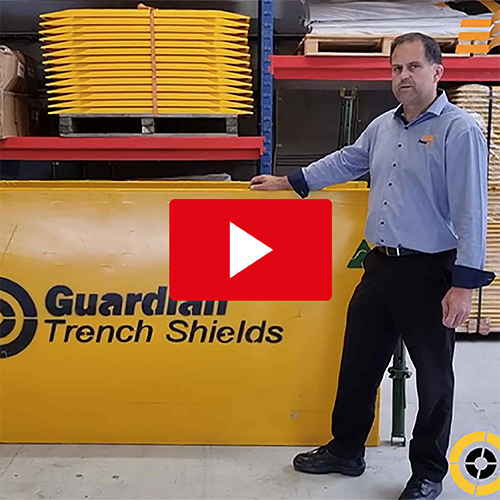
Watch this video for answers to the most asked questions about the #2301 Guardian Aluminium Trench Shield.
Guardian Trench Shields Have Your Back
If you need a strong, lightweight trench shield system for civil or drainage work that can fit on the back of a ute, Guardian has the solution.
How much does a small Guardian shield weigh?
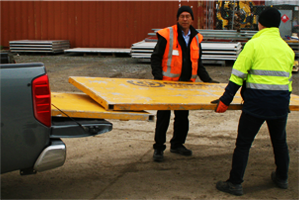
Because the system is aluminium, each panel weighs only around 55kg. That means two people can safely handle it. By comparison, a steel panel would typically weigh two to three times as much.
This makes the #2301 shield an excellent all-round maintenance unit, particularly useful for:
• Tight sites
• Restricted access areas
• Smaller trench work
Even when fully assembled with two panels, four struts, and eight pins and clips, the system weighs only 150kg. This means a small 1.7 tonne digger can easily and safely lift it using the built-in lifting points.
Watch the video in this blog to see how quickly it can be assembled.
How do the small guardian shields save me time on site?
The mobility of the system is one of its biggest advantages.
Because the shield can be dismantled in minutes, it can be moved quickly around site or between jobs. That flexibility helps keep crews working and reduces downtime.
Another advantage of aluminium construction is that it won’t rust like steel. In New Zealand’s wet and muddy ground conditions, this helps extend the life of the equipment and keeps the system easier to maintain.
How high is the strut clearance?
The standard under strut clearance is 290mm. There is also an option to add 600mm legs to the bottom of the shield which takes the under-strut ground clearance up to 890mm.
What size are the shields and struts?
The shield panels are 2.4m long by 1.2m high and they come with adjustable spreader bars or struts that allow the shield to suit different trench widths while maintaining pressure against trench walls.
Standard 600–900mm adjustable struts are included, or they can be swapped for 1m–1.8m struts depending on the application.
Different strut mounting points on the panels also allow crews to work around pipes, rather than being restricted to a single configuration.
What other configurations can the small Guardian shield form?
The system can also be used in several other ways depending on the job.
For example:
• Their regular setting with the two shield panels held apart by structs.
• Panels can be installed vertically, which works well for shorter trench sections.
• The system can also be configured to create a 2.4m square manhole using corner joiners instead of struts.
• The shields can be made into a 3-sided vertical box to go at the end of a trench.
• The shields can be horizontally stacked on top of each other to form a 4.8m deep by 1.2m wide shield.
What is the small Guardian shield’s load capacity?
It has a safe working load of 20 to 50 kPa, depending on where the struts are positioned.
Each shield panel includes a reference guide showing correct strut placement and safe operating instructions.
What standards is the small Guardian shield rated to?
Certificates: British and European Standards BS. EN 13331.1 and 13331.2, Australia & New Zealand Standard AS 4744.1-2000 & United States Standard, OSHA Sub Part P.
Guardian trench shields are fully certified and meet or exceed standards in:
• New Zealand
• Australia
• United States
• Britain
• Europe
Each shield includes a compliance plate identifying the standards it meets.
Certification documents and a Safe Use Manual are also available to support your Health and Safety requirements.
Purchase or Hire?
Guardian offers both purchase and hire options, and many companies use a mix of both depending on their workload.
Every business and project is different.
For smaller companies or short-term projects, trench shield hire is often the most practical option. It gives crews access to the right protection without needing to commit to permanent equipment.
Guardian aims to stay flexible so we can meet changing project needs.
How long does it take to set up a small Guardian 2.4m Aluminium shield?
Talk to Us About Your Next Job
Across New Zealand worksites every day, Guardian Trench Shields protect crews from trench collapse and the serious injuries that can follow.
Anyone working in civil construction understands the risks. Trenches are one of the most dangerous places on site. Ground conditions can change quickly, and trench walls can collapse without warning (learn more about the speed a trench can collapse in).
Having the right protection in place and following proper procedures isn’t just good practice. It’s required by law. It also protects your crew, keeps work moving, and shows your commitment to safety on site.
If you’re planning upcoming drainage or civil work, talk to the Guardian team about the right trench protection for your site.
Our team understands civil construction and can help you choose the equipment that keeps crews protected and projects moving.